
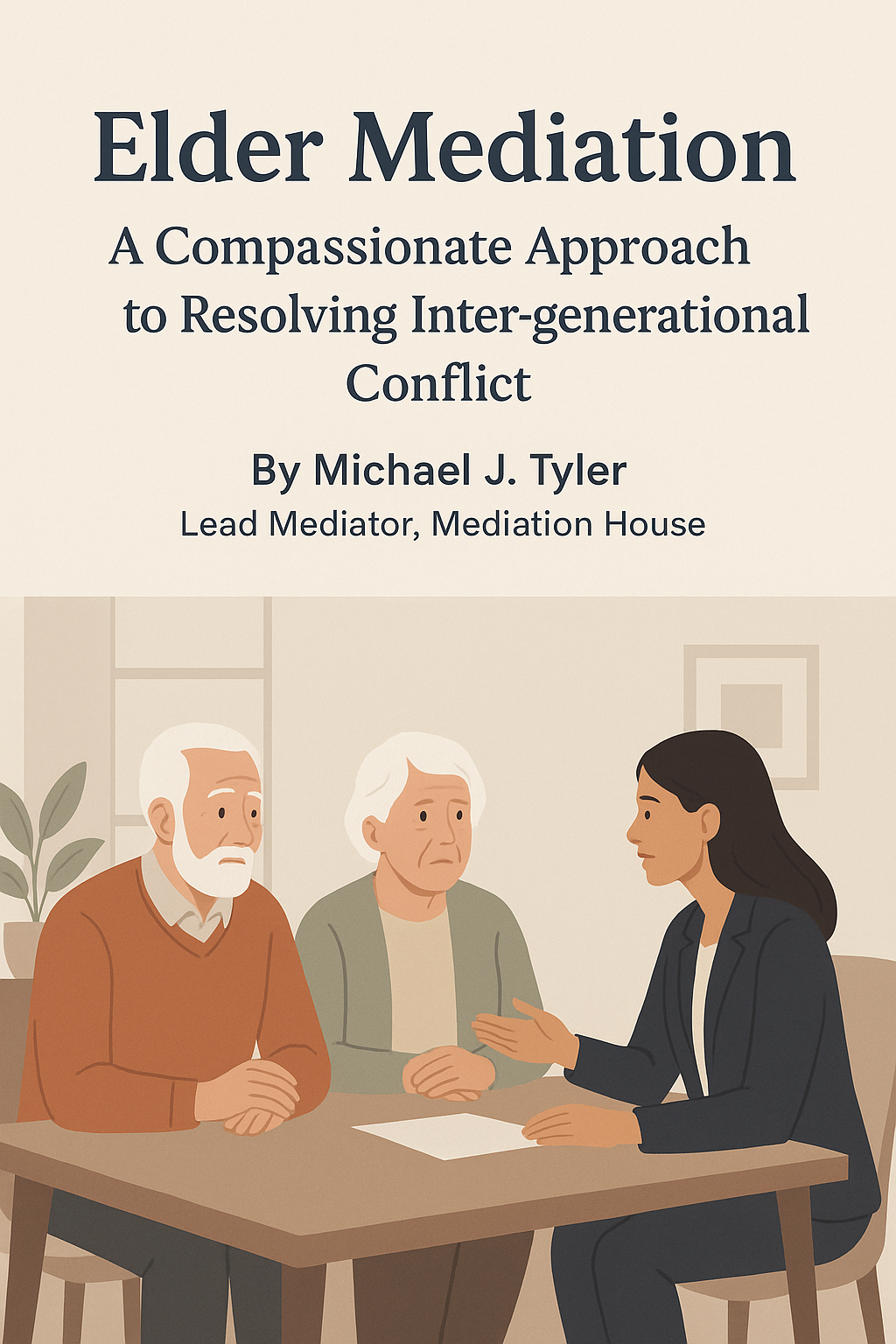

Elder Mediation: A Compassionate Approach to Resolving Inter-generational Conflict
By Michael J. Tyler
Lead Mediator, Mediation House
Introduction
In my work as a mediator specialising in elder matters, I have repeatedly seen the same pattern: a family grappling with transition, fraught emotions and unclear communication, involving older family members whose needs and voices must not be lost. Elder mediation offers a pathway to healing and clarity.
This blog explores why elder mediation matters, key principles to guide the process, typical challenges and practical tips for families, care-providers and mediators alike.
Why elder mediation matters
The late-life stage often brings change: health, mobility, cognitive capacity, living arrangements, finances and family roles all shift. In many families, older parents (or grandparents) remain the heart of the family, but may become less able to voice their preferences or assert their autonomy. Simultaneously, adult children may worry about safety, want to step in, and feel constrained by emotional history.
Without an intentional process, these dynamics can lead to:
- unresolved resentment or guilt (“you never asked me”, “why didn’t you tell me?”)
- decisions made behind closed doors, excluding the elder’s voice
- siblings or mixed-generational family members in conflict over care, financial provision, legacy
- older family members feeling disempowered, isolated or ignored
Mediation gives the elder a space to be heard, ensures that family relationships are respected, and helps families co-design steps forward rather than relying on imposed solutions.
Core principles of elder mediation
From my practice, I emphasise the following four pillars:
- Respect for autonomy and voice
Regardless of age or capacity, an older person should have whatever voice they can, in a way that is dignified. We aim to support rather than override that voice. - Inter-generational empathy and role awareness
We ask adult children, grandchildren or other family members to reflect on the inter‐generational dynamic, not just what is legally or financially “right” but what is relationally meaningful. - Safety, clarity and informed consent
Many elder matters involve health, cognition or vulnerability. Mediation must ensure that older persons are appropriately supported (for example by having an independent advisor or being informed of their rights). The setting must be safe and non‐coercive. - Flexibility and creativity in solution design
Unlike purely legal or financial models, mediation allows room for creative solutions: phased transitions, family agreements revisited over time, mutual support arrangements, legacy conversations, non-monetary contributions, etc.
Typical scenarios in which elder mediation is useful
Here are a few patterns I frequently encounter:
- The parent wants to remain living at home, but adult children disagree about safety and think moving into care may be necessary.
- The elder is frail or has early cognitive change, and the family is divided about who should have decision-making responsibility (health, finances, living arrangements).
- Siblings disagree about whether to step in, whether a gift or inheritance is fair, or whether the parent’s wishes are known and respected.
- The elder has been financially supporting family members, and now the situation is changing (for example a move to aged care, sale of the home) and expectations differ.
- The elder wants to have a meaningful “legacy conversation” but the family shies away from discussing death, estate, desires for end-of-life, etc.
Mediation offers a structured, facilitated conversation in each of these scenarios.
Challenges to be aware of
Elder mediation is rewarding but also complex. Some of the common challenges:
- Capacity issues: When an older person has cognitive impairment, there are ethical and legal thresholds about consent and participation. The mediator must be alert to signs of diminished capacity and may need to coordinate with independent advisors or guardians.
- Power imbalances: Adult children may dominate the discussion, or the elder may defer out of habit or respect. The mediator must ensure the elder’s voice is heard.
- Emotional history: Long-standing family patterns (resentment, sibling rivalry, guilt) often surface. The mediator needs to manage both the surface issue (e.g., living arrangements) and underlying relational dynamics.
- Complex legal/financial issues: Often the mediation touches on estate planning, aged-care funding, guardianship, powers of attorney. While the mediator isn’t giving legal advice, coordination with legal/financial professionals is often needed.
- Timing and readiness: Sometimes families come when a crisis has already erupted (“it’s either moved into aged care now or we have conflict”). Early intervention is preferable, but many wait until the pressure builds.
Practical tips for families considering elder mediation
If you’re thinking about mediation with your older parent(s) and family, here are some practical suggestions:
- Choose an experienced mediator: Look for someone with elder-law awareness, understanding of aged-care, decision-making capacity, and family dynamics.
- Prepare the older person: Ensure they understand the purpose of the mediation, their role, and that the setting is supportive. Consider having a trusted third person or advisor present to support the elder.
- Gather key information ahead of time: What are the elder’s wishes (even if informal)? What financial/health decisions are likely ahead? Who are the key family stakeholders? This helps frame the agenda.
- Set the agenda together: The elder should be given a chance to state their priorities (“I want to stay at home as long as possible”, “I want to pass the house to my grandchildren”, etc.).
- Focus on values, not only decisions: Ask questions like: “What matters most to you at this stage of life?”, “How do you want your family to remember these years?”, “What kind of support do you want from others?”
- Plan follow-up: Elder transitions often unfold over time. Consider building in a review session six months later to revisit the arrangements and adjust as needed.
A short case illustration (anonymised)
I recently worked with a family in which Mrs S (aged 82) wanted to continue living at her home of 50 years. Her two adult children were concerned about her safety: one lived interstate and was worried about emergency response; the other lived locally but worked full-time and felt unable to provide daily support. The conflict boiled down to: should Mrs S move to a retirement village now (which she resisted) or stay at home with support (which the children feared was unsafe)?
In the mediation, we spent the first session letting Mrs S speak uninterrupted about what her home meant to her, what she loved about it, what she feared. The children each spoke about their worries and perceived obligations. The mediator helped surface hidden concerns: the local child felt resentment because the interstate sibling had not helped as much; Mrs S felt guilt that the move would impose on the children.
By the end, the family agreed on a phased plan: Mrs S remains at home, a home-care service will provide 3 visits per week, the local child will take on a weekend check-in, the interstate child will contribute financially toward a pendant emergency alarm, and the siblings will reconvene in six months to review. Mrs S also drafted a letter expressing her wishes for the future, which she shared with the family.
That outcome preserved Mrs S’s autonomy, acknowledged the children’s concerns, and created a system of mutual accountability and review.
Conclusion
Elder mediation is not about finding a “one-size-fits-all” fix; it is about listening, respecting voice, designing transition, and healing relationships. For families navigating the complexities of ageing, inter-generational roles and evolving care, mediation offers a pathway to move forward with dignity, clarity and connection.
If you’re in Sydney or around Australia and are facing these kinds of family conversations, I encourage you to consider the value of mediation early, when there is still space to shape the future rather than react to crisis.
Michael J. Tyler
Lead Mediator, Mediation House
Sydney