

Trump, Greenland, and the Selective Use of International Law
Michael J. Tyler
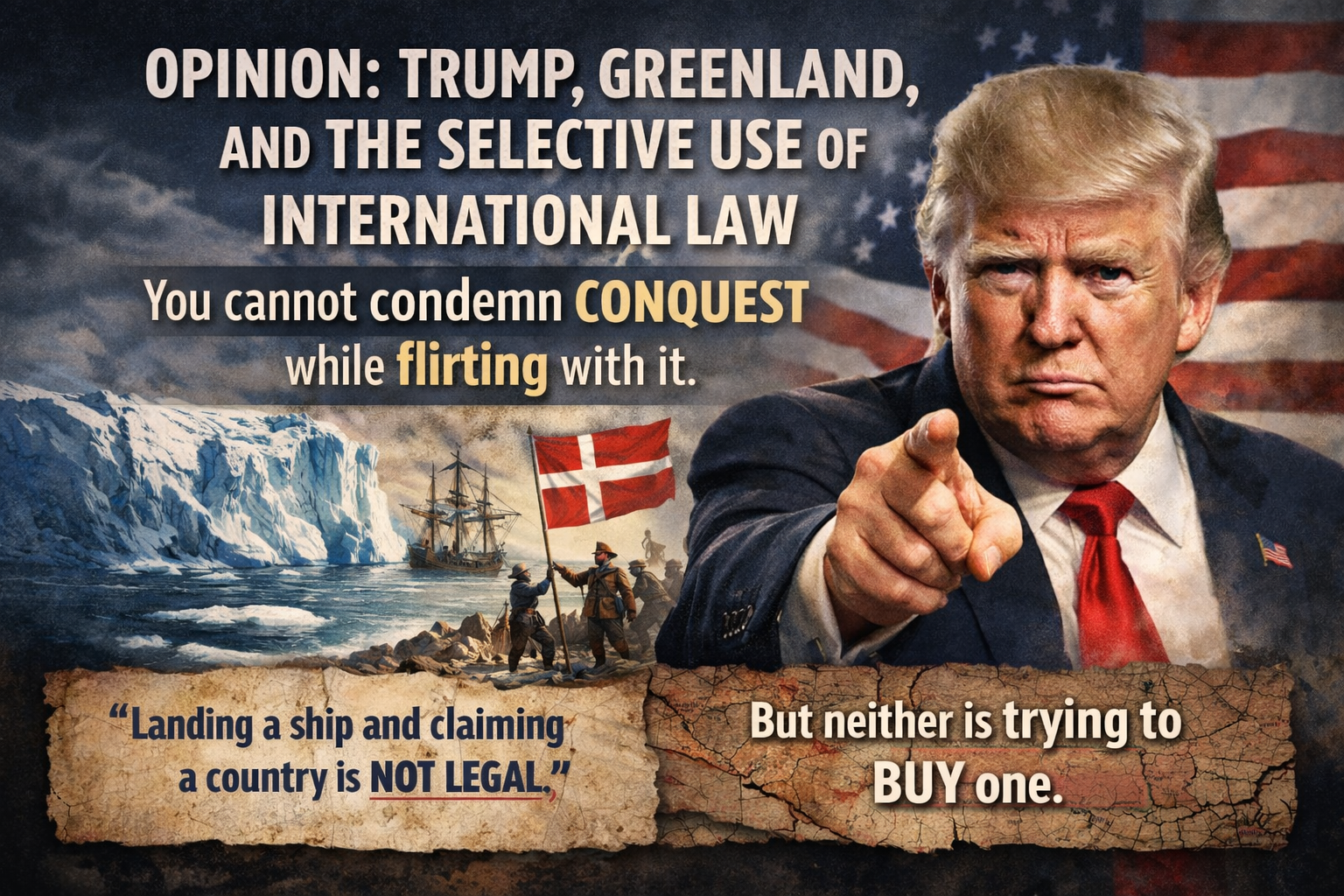
When Donald Trump declared that landing a ship and claiming a country is not legal, he was stating a principle that is firmly settled in modern international law. Territorial acquisition by force, symbolism, or unilateral assertion has been unlawful for decades. What makes Trump’s statement noteworthy is not its correctness, but the inconsistency with which he applies it, particularly in relation to Greenland.
Greenland is not unclaimed land. It is an autonomous territory within the Kingdom of Denmark, with its status grounded in centuries of administration and reinforced through modern constitutional arrangements. Its people exercise self government over internal affairs, while Denmark retains responsibility for foreign policy and defence. This arrangement is recognised and uncontested under international law.
Modern sovereignty rests on recognised title, effective governance, and the right of peoples to self determination. The colonial practice of planting a flag or announcing possession has long been abandoned. Trump’s rejection of conquest by landing a ship aligns with this legal reality. His repeated public interest in acquiring Greenland does not.
During his presidency, Trump floated the idea of purchasing Greenland, at times framing it as a commercial transaction and at others as a strategic necessity for the United States. While defenders dismissed the remarks as unconventional diplomacy, the underlying assumption was clear. That territory might be transferred through economic leverage or political pressure, regardless of the wishes of its people. This assumption conflicts directly with the principles Trump claimed to uphold.
International law does not distinguish between crude and polite forms of territorial acquisition. Sovereignty cannot be overridden by a cheque book any more than it can be overridden by a warship. Consent obtained through imbalance of power is not genuine consent, a lesson drawn painfully from nineteenth century imperial history. Treaties signed under economic or political pressure were once considered lawful. They are now widely regarded as illegitimate, prompting the development of modern rules designed to prevent their repetition.
The legal framework governing the Arctic reinforces this point. Under the United Nations Convention on the Law of the Sea, maritime rights over territorial waters, exclusive economic zones, and continental shelves flow directly from recognised sovereignty over land territory. Denmark’s sovereignty over Greenland gives rise to these rights. Strategic interest, military presence, or economic value does not alter this legal reality.
The inconsistency in Trump’s position mirrors a broader problem in international relations. Powerful states often invoke international law when it restrains rivals, yet treat it as flexible when it constrains themselves. The United States rightly condemns unlawful territorial claims elsewhere, insisting that borders cannot be altered by force or unilateral assertion. These arguments depend on a stable and respected legal order. That same order is weakened when its principles are treated as optional.
This matters because international law is not self enforcing. It relies on consistent respect, particularly by influential states. When leaders selectively apply legal principles, they erode the norms that prevent conflict and coercion. The danger lies not only in what is claimed, but in what is normalised. If sovereignty is framed as negotiable when strategic interests are high enough, the protection afforded to smaller states and peoples is diminished everywhere.
Trump was right in one narrow respect. Landing a ship and claiming a country is not legal. But legality does not reappear simply because the method of acquisition is economic rather than military, or because the target is governed by an ally rather than an adversary. International law does not change with power, convenience, or personality.
Greenland is not a commodity. Its people are not a strategic asset to be traded. And sovereignty is not something that can be condemned in principle while quietly tested in practice.