
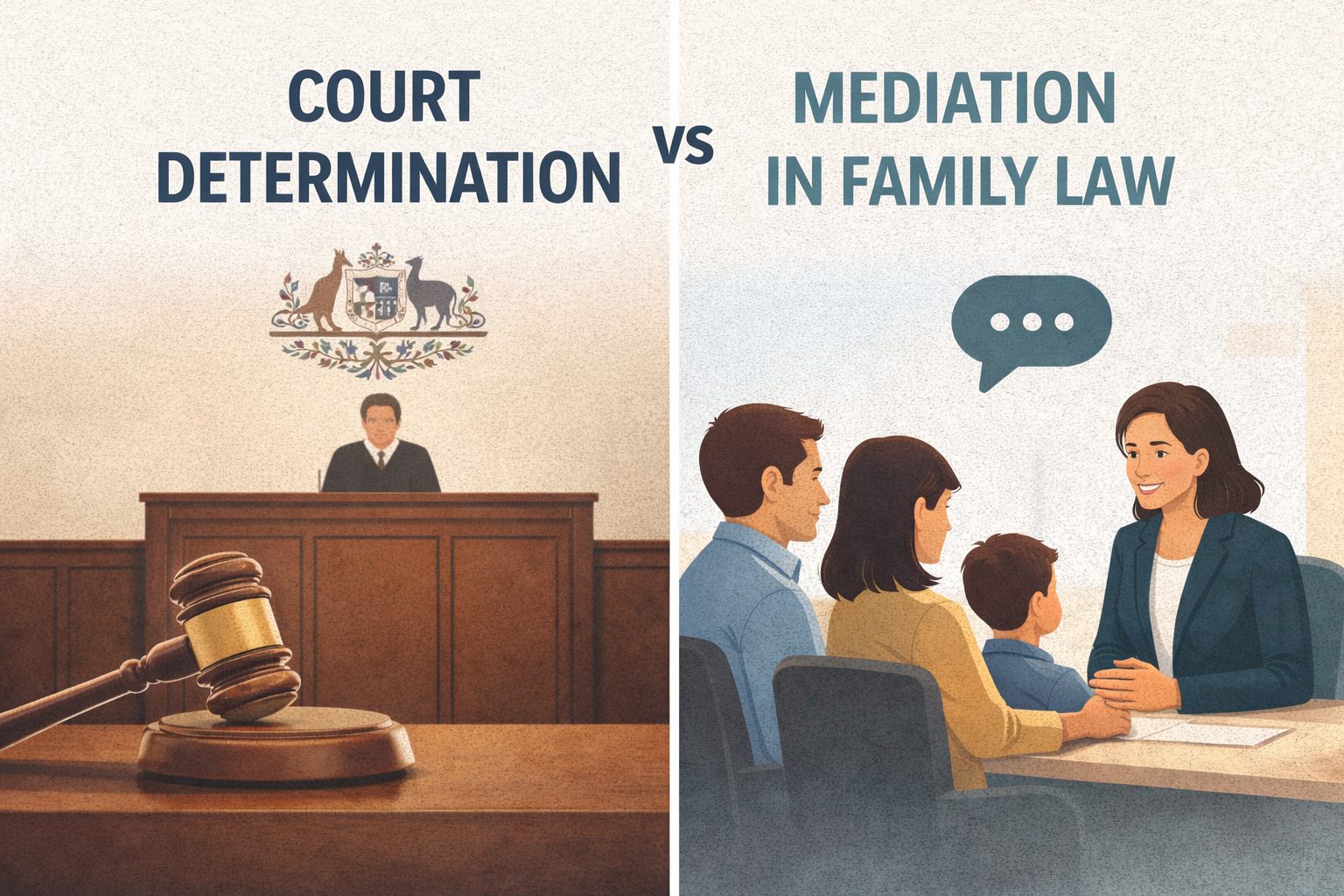

Comparative Family Law: Court Determination Versus Mediation Based Resolution
Inroduction
Family law disputes are among the most personal and emotionally complex matters within the legal system. In Australia, separating couples generally resolve issues relating to children, property and finances either through court determination or through mediation and other forms of family dispute resolution. While both pathways exist within the family law framework, they differ significantly in process, cost, impact and long term outcomes.
Understanding these differences is essential for families deciding how best to resolve their disputes.
The court based approach to family law
Court proceedings are formal, adversarial and structured by strict procedural rules. Each party presents evidence and legal arguments, and a judge makes binding decisions based on the law and the facts presented. This process can be necessary where there are serious safety concerns, entrenched conflict or an inability to negotiate in good faith.
However, court proceedings are often lengthy and expensive. Matters involving children or complex property issues can take months or even years to resolve. During this time, families may experience ongoing uncertainty, stress and financial pressure. The adversarial nature of litigation can also deepen conflict, particularly where communication between parents is already strained.
Court outcomes are imposed rather than negotiated. While legally binding, they may not always reflect the practical realities of family life or the unique needs of the individuals involved. Compliance can become an ongoing issue, leading to further disputes and enforcement proceedings.
Mediation and family dispute resolution
Mediation and family dispute resolution offer a fundamentally different approach. These processes involve an independent and accredited practitioner who assists the parties to identify issues, communicate effectively and work towards mutually acceptable agreements. The focus is on problem solving rather than blame or past conduct.
In Australia, family dispute resolution is strongly encouraged and, in many parenting matters, is a required step before commencing court proceedings. This reflects recognition that negotiated agreements are often more sustainable and better aligned with the best interests of children.
Mediation is generally faster and less costly than litigation. Sessions can be scheduled flexibly and outcomes may be reached in a matter of weeks rather than months. The process is confidential, allowing parties to speak openly without fear that their discussions will be used against them in court.
Impact on children and family relationships
One of the most significant differences between court and mediation lies in the impact on children. Court proceedings can increase parental conflict, exposing children to prolonged stress and uncertainty. Mediation encourages cooperative parenting and focuses on future arrangements rather than past grievances.
When parents reach their own agreements, they are more likely to comply with them and to communicate more effectively in the future. This can provide children with greater stability and a reduced risk of ongoing conflict.
Flexibility and control
Mediation allows families to craft solutions that suit their specific circumstances. Agreements can address practical issues such as schooling, holidays, communication methods and cultural considerations in ways that court orders often cannot. Parties retain control over both the process and the outcome.
By contrast, court decisions are constrained by legal frameworks and judicial discretion. While courts strive to act in the best interests of children and to achieve just outcomes, they cannot tailor solutions to the same extent as negotiated agreements.
When court intervention is necessary
Despite its advantages, mediation is not appropriate in every case. Situations involving family violence, coercive control or serious power imbalances may require court intervention to ensure safety and fairness. The court also plays a vital role where urgent orders or legal enforcement are required.
In these circumstances, litigation provides protection, accountability and clear legal authority.
A balanced family law system
Australian family law is designed to balance both approaches. Mediation and court processes are not competing systems but complementary pathways. Mediation aims to resolve disputes early and constructively, while the courts remain available when agreement cannot be reached or where protection is needed.
For many families, mediation offers a more humane, efficient and empowering way to resolve disputes. It supports cooperation, reduces conflict and helps families move forward with dignity and stability.
Choosing the appropriate pathway requires careful consideration of the family’s circumstances, the nature of the dispute and the needs of any children involved. In most cases, informed guidance and early engagement with mediation can make a significant and positive difference.