

From one profession to several: how elder, family and property mediation have split apart
Mediation House | Elasmo Legal Group
Mediation used to be talked about as a single skill set, applied wherever a dispute needed it. That is no longer an accurate picture of the profession. Three areas in particular, elder mediation, family dispute resolution and property mediation, have each developed their own training pathways, standards and practice norms. Understanding how they differ matters for anyone deciding which door to walk through.
Elder mediation: the newest recognised specialisation
Elder mediation has just been formally approved as a specialisation by the Australian Mediation and Dispute Resolution Standards Board. A dedicated 40 hour training program, Elder Mediation: Essential Knowledge, Values and Skills, became available to Australian and New Zealand applicants from January 2026.
The specialisation exists because elder disputes are not simply family disputes with older participants. They involve questions of capacity, guardianship, aged care decisions and the older person's own right to participate in decisions about their life, not just be spoken about by adult children on their behalf. A trial mediation program run by Benetas and FMC Mediation and Counselling Victoria has shown promising early results in aged care conflicts specifically, preserving family relationships and reducing decision-making stress for everyone involved, including the older person at the centre of the dispute.
This is a growth area for a straightforward demographic reason, an ageing population means more disputes over aged care placement, financial management and end of life decisions, and courts are a poor forum for most of them.
Family dispute resolution: a more structured intake process
FDR has existed as a distinct field for longer, but it changed materially on 1 April 2025 when the Family Law (Family Dispute Resolution Practitioners) Regulations 2025 came into force. The regulations impose enhanced screening obligations, updated requirements for section 60I certificates, tighter recordkeeping and revised registration and continuing professional development requirements.
The practical shift is at intake. Screening for family violence and power imbalance is no longer a background judgement call, it is now a documented, structured step with clearer consequences attached to how it is recorded. For parties, this means the FDR process looks and feels more formal at the front end than it did two years ago, even though the negotiation itself has not fundamentally changed.
Property mediation: shaped by how courts now decide
Property mediation sits closest to litigation of the three, because mediators are effectively helping parties predict what a court would do with their asset pool. The Family Law Amendment Act 2025 changed that prediction exercise from 10 June 2025, codifying a clearer sequence for property settlement, identify property and liabilities, assess contributions including the effect of family violence, then weigh current and future circumstances.
A property mediator's job has always been part negotiation, part reality testing against likely court outcomes. That job just got more technical, because the contribution assessment now has an explicit family violence limb that did not exist in the same form before.
Why the split matters
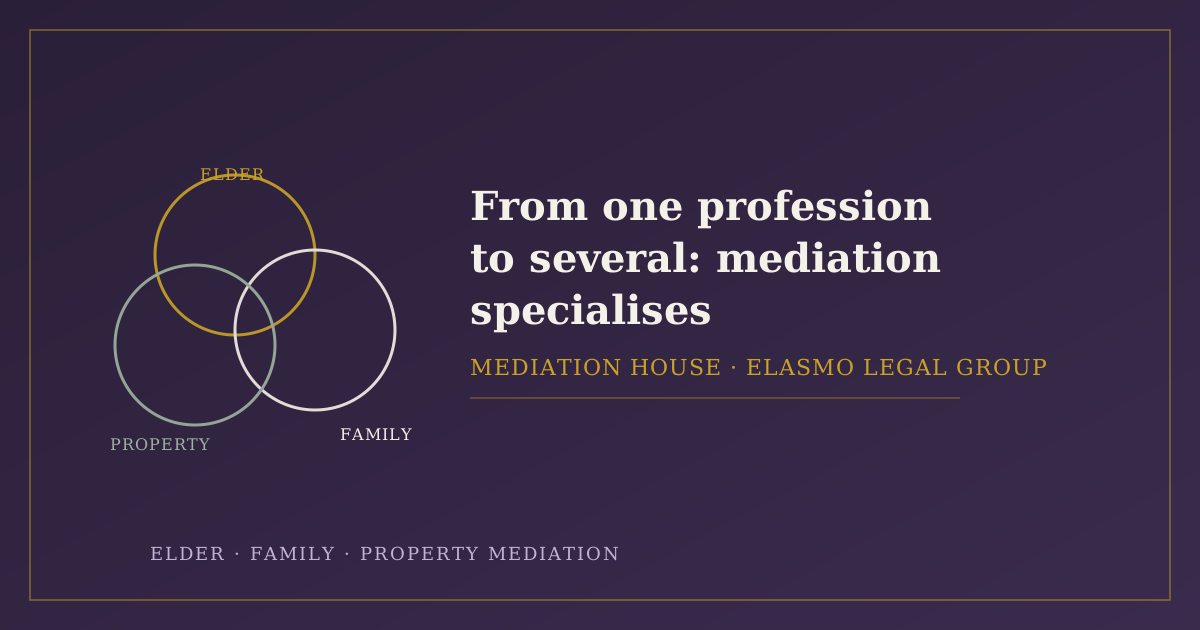
Ten years ago a generalist mediator could reasonably cover all three areas. That is harder to justify today. Elder mediation demands familiarity with guardianship and capacity law. FDR demands current knowledge of screening obligations and certificate requirements. Property mediation demands a working grasp of how courts assess contributions under the amended Act. Firms offering all three, as we do across our mediation and ADR arms, need practitioners who specialise rather than generalise, and referral pathways between them for matters that straddle more than one category, such as an elder dispute that is also a property dispute within a blended family.
Sources: Elder Mediation Australasian Network; Mediation program helping to resolve conflicts in aged care, trial shows, Australian Ageing Agenda; Family Law Amendment Act 2025, key changes; Family law (property) changes from 10 June 2025, Federal Circuit and Family Court of Australia