
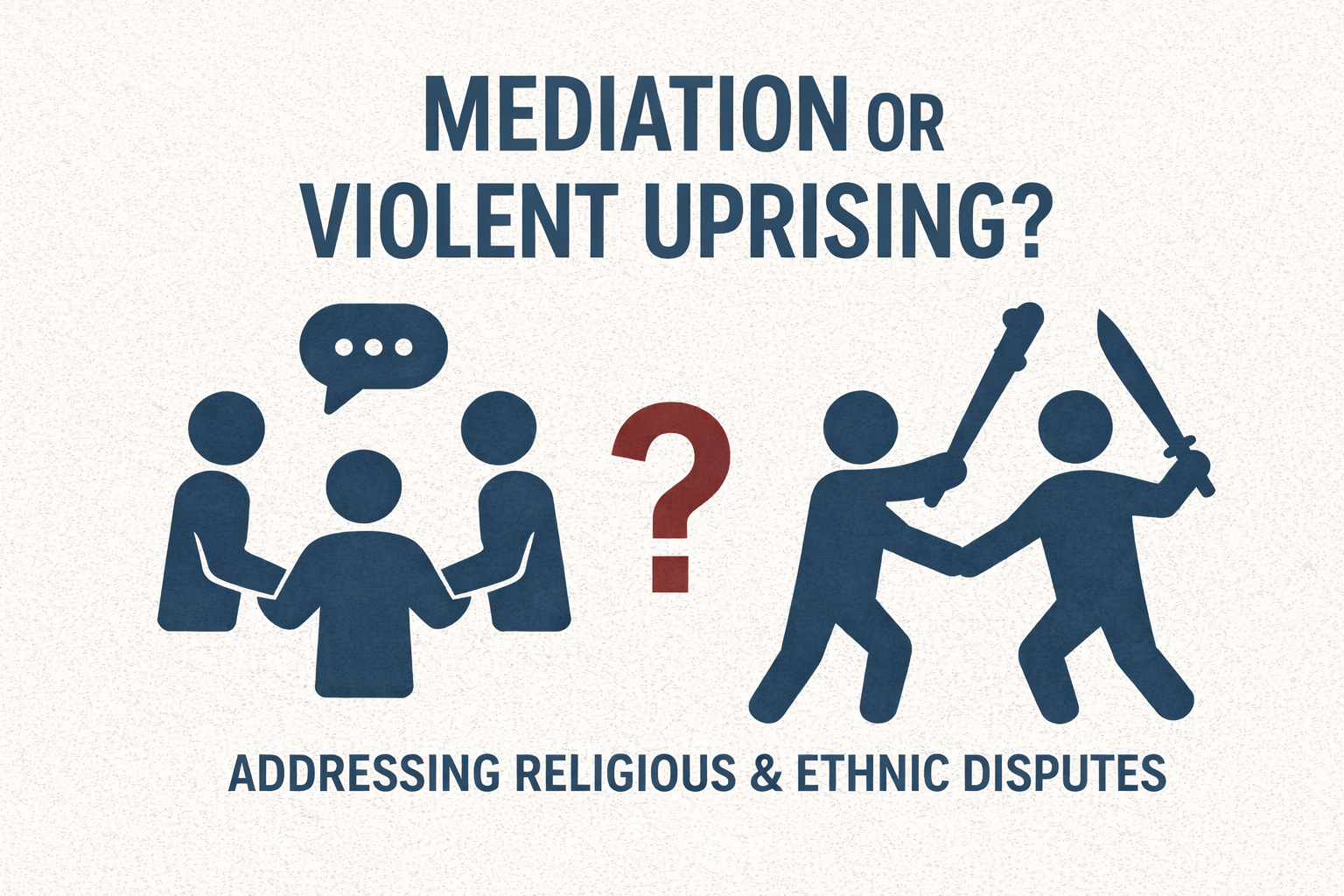

Mediation Compared to Violence
Disputes between religious and ethnic groups are among the most complex and emotionally charged forms of conflict. They are often rooted in history, identity, belief systems and perceived injustice. When such disputes are unmanaged or exploited, they can escalate into violent uprising, causing profound human suffering, social fragmentation and long term instability. Mediation offers a fundamentally different and constructive approach to resolving these disputes.
While mediation is not a universal solution for every conflict, it provides a framework for dialogue and resolution that stands in stark contrast to violence.
The consequences of violent uprising
Violent uprising is often framed as a response to oppression or exclusion, but its consequences are almost always devastating. Violence results in loss of life, displacement of communities, destruction of infrastructure and deep psychological trauma. It entrenches fear and mistrust between groups and hardens identities around grievance and retaliation.
Once violence occurs, opportunities for compromise diminish. Each act of aggression reinforces narratives of victimhood and justification for further harm. Legal systems, governance structures and community cohesion are often severely weakened or destroyed, making recovery slow and uncertain.
Violence may draw attention to grievances, but it rarely resolves the underlying causes of conflict.
Mediation as an alternative pathway
Mediation offers a non violent and structured process for addressing religious and ethnic disputes. It provides a forum in which parties can articulate grievances, fears and aspirations without resorting to force. Mediators do not impose solutions but facilitate dialogue, helping parties explore shared interests and realistic options for coexistence.
In religious and ethnic contexts, mediation recognises the importance of identity and dignity. It allows groups to be heard and acknowledged, which is often a critical first step toward reducing hostility. By focusing on communication and mutual understanding, mediation helps de escalate tension and prevent cycles of retaliation.
Why mediation is effective in identity based conflicts
Mediation is particularly suited to disputes where relationships and long term coexistence matter. Religious and ethnic groups frequently live alongside one another for generations. Violent outcomes make peaceful coexistence increasingly difficult, while mediated agreements can establish frameworks for cooperation, respect and shared governance.
Mediation also allows for culturally sensitive processes. Skilled mediators adapt approaches to respect belief systems, customs and power dynamics. This flexibility is rarely available in adversarial legal processes or military responses.
Importantly, mediation addresses both practical and emotional dimensions of conflict. It acknowledges historical grievances while focusing on future arrangements that reduce the risk of renewed violence.
Limitations and realistic expectations
Mediation is not a replacement for law enforcement, humanitarian intervention or judicial processes where serious crimes have occurred. In situations of active violence or extreme power imbalance, mediation may only be possible after a degree of stability is restored.
However, even in post conflict environments, mediation plays a critical role in reconciliation, peace building and transitional justice. It supports dialogue where formal legal processes alone cannot rebuild trust or social cohesion.
A choice between destruction and dialogue
The comparison between mediation and violent uprising highlights a fundamental choice in how disputes are addressed. Violence seeks to dominate or eliminate the other side. Mediation seeks to understand, negotiate and coexist.
While mediation requires patience, good faith and skilled facilitation, its outcomes are far more sustainable. It preserves life, protects communities and creates pathways for long term peace rather than perpetual conflict.
In a world where religious and ethnic diversity is a reality, mediation offers a principled and practical alternative to violence. It does not deny the depth of grievance or suffering involved, but it provides a means of addressing conflict without compounding harm.