
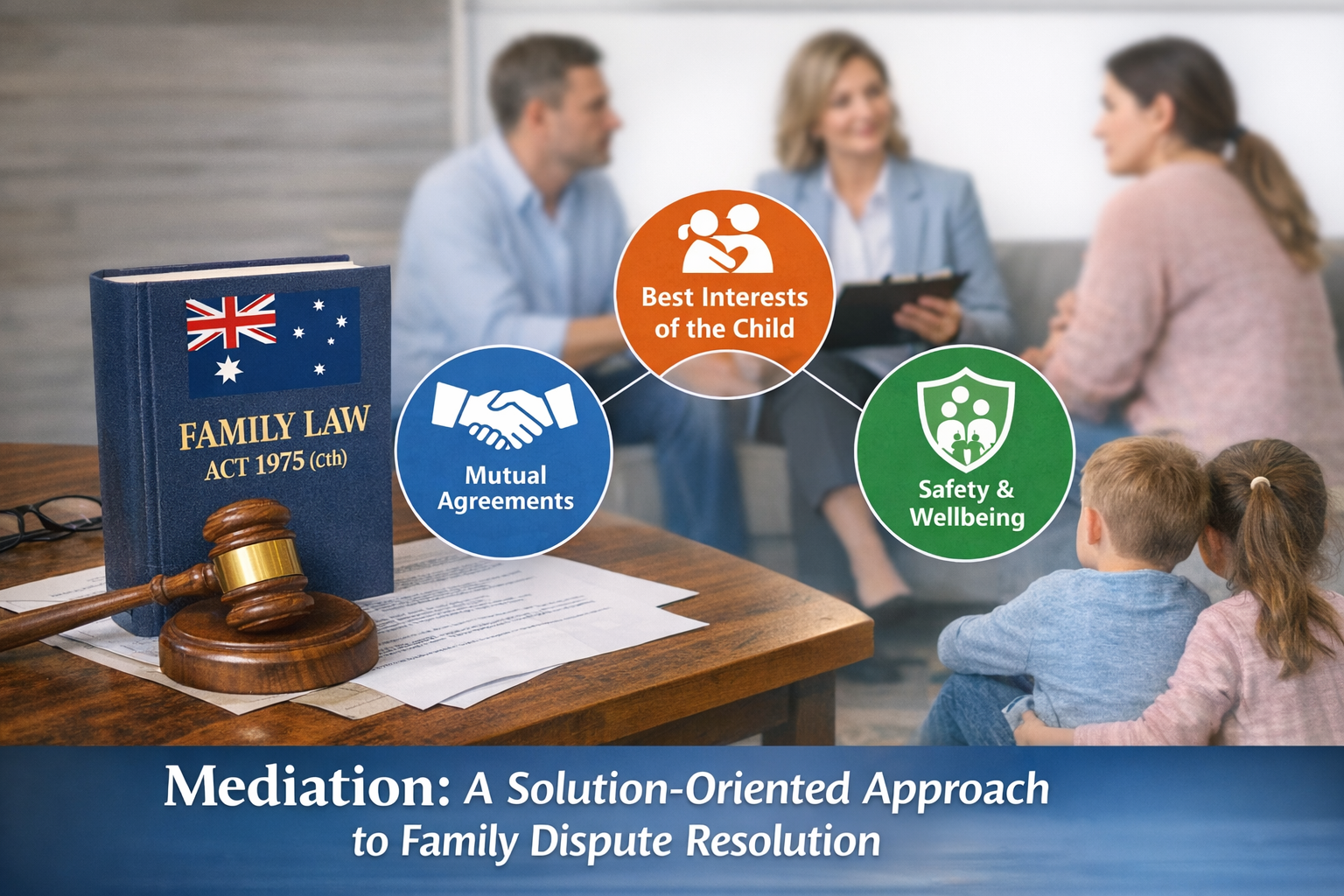

Mediation as a Solution-Oriented Method of Family Dispute Resolution in Australian Family Law
Within the Australian family law framework, mediation is recognised as a solution-oriented method of family dispute resolution because it is embedded in legislation as a primary mechanism for assisting separating families to resolve disputes in a manner that prioritises the best interests of children, minimises conflict and supports cooperative parenting arrangements. The Family Law Act 1975 (Cth) reflects a clear policy position that adversarial processes are often ill-suited to resolving family disputes and therefore promotes dispute resolution outside the court system.
Section 60CA of the Family Law Act 1975 (Cth) establishes that in making a parenting order, the court must regard the best interests of the child as the paramount consideration. Mediation directly supports this principle by shifting the focus away from parental conflict and towards arrangements that promote children’s safety, wellbeing and development. Through structured and facilitated discussions, mediation encourages parents to consider how proposed arrangements will affect their children in both the short and long term.
Section 60CC sets out the factors to be considered in determining a child’s best interests, including the benefit to the child of having a meaningful relationship with both parents and the need to protect the child from physical or psychological harm. Mediation provides a forum in which these considerations can be explored in a practical and balanced way. By facilitating respectful communication and addressing issues of safety, mediation assists parents to develop parenting arrangements that are consistent with these statutory considerations, while recognising that protection from harm must take precedence where there is a risk of family violence or abuse.
Australian family law also emphasises shared parental responsibility, subject to safety considerations. Mediation supports this framework by enabling parents to discuss how parental responsibility will be exercised in practice, including decision making, communication methods and time arrangements. This collaborative approach aligns with the objectives of Part VII of the Act by promoting cooperative parenting and reducing ongoing conflict.
Section 60I of the Family Law Act 1975 (Cth) requires parties, in most circumstances, to make a genuine effort to resolve parenting disputes through Family Dispute Resolution before commencing court proceedings. This requirement reflects a legislative intention to resolve disputes at an early stage and to limit the emotional, financial and psychological costs associated with litigation. Mediation is solution-oriented in this context because it aims to resolve disputes efficiently while preserving relationships and supporting family stability.
Mediation also aligns with the Act’s emphasis on protecting parties from harm. Family Dispute Resolution practitioners are required to conduct intake, risk screening and suitability assessments, particularly in relation to family violence, child abuse and power imbalances. These safeguards ensure that mediation is only used where appropriate and that safety considerations inform both the process and any outcomes.
A further strength of mediation within the Australian family law system is its flexibility. While court orders are constrained by statutory requirements, mediated agreements such as parenting plans allow families to develop tailored solutions that reflect their individual circumstances, cultural contexts and practical realities. These agreements operate within the framework of the Family Law Act 1975 (Cth) while allowing for adaptable arrangements that can evolve as children’s needs change.
In summary, mediation is solution-oriented within Australian family law because it gives practical effect to legislative principles set out in sections 60CA, 60CC and 60I of the Family Law Act 1975 (Cth). By prioritising the best interests of children, promoting cooperative parental responsibility and encouraging early, safe and constructive resolution of disputes, mediation serves as a central mechanism for resolving family conflict in Australia.